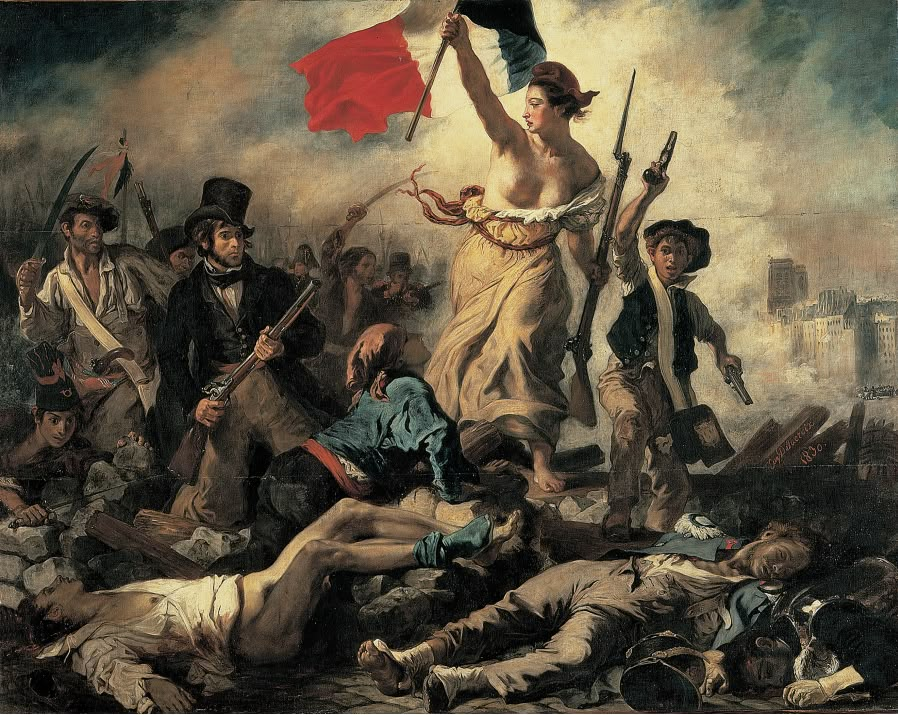
This painting is called “Liberty Leading the People” (French: La Liberté guidant le peuple), and it is a painting by Eugène Delacroix commemorating the July Revolution of 1830, which toppled King Charles X of France.
A woman personifying the concept and the Goddess of Liberty leads the people forward over a barricade and the bodies of the fallen, holding the flag of the French Revolution, the tri-colour flag, which remains France’s national flag, in one hand and brandishing a bayonetted musket with the other.
The figure of Liberty is also viewed as a symbol of France and the French Republic known as Marianne.
By the time Delacroix painted Liberty Leading the People, he was already the acknowledged leader of the Romantic school in French painting.
Delacroix painted his work in the autumn of 1830. In a letter to his brother dated 21 October, he wrote: “My bad mood is vanishing thanks to hard work. I’ve embarked on a modern subject—a barricade. And if I haven’t fought for my country at least I’ll paint for her.” The painting was first exhibited at the official Salon of 1831.
Delacroix depicted Liberty as both an allegorical goddess-figure and a robust woman of the people. The mound of corpses acts as a kind of pedestal from which Liberty strides, barefoot and bare-breasted, out of the canvas and into the space of the viewer. The Phrygian cap she wears had come to symbolize liberty during the first French Revolution, of 1789–94.
The painting has been seen as a marker to the end of the Age of Enlightenment, as many scholars see the end of the French Revolution as the start of the romantic era.
A.G. Munson