
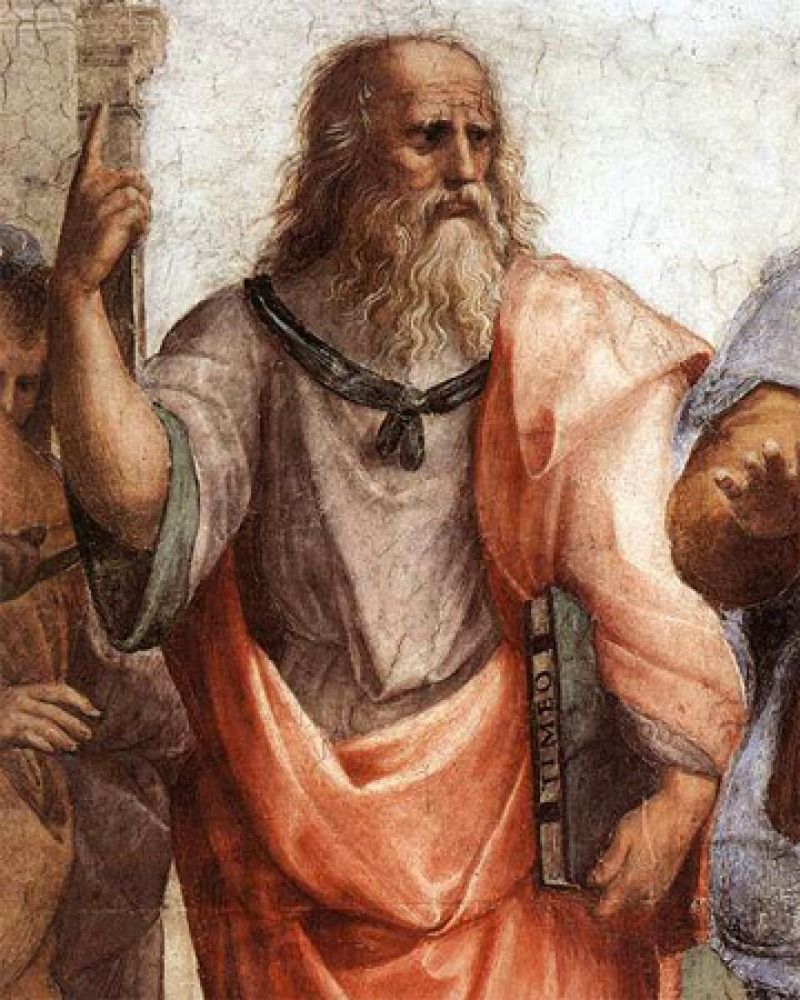
Plato (427–347 BC)
was an ancient Greek philosopher, student of Socrates, and teacher of Aristotle, born into an aristocratic Athenian family during a period of political upheaval, including the Peloponnesian War and the brief rule of the Thirty Tyrants, which influenced his views on justice and governance. He founded the Academy in Athens, one of the earliest institutions of higher learning in the Western world.
Plato’s philosophy centers on the pursuit of truth, the nature of reality, and the ideal forms that underlie the physical world.
Theory of Forms
Plato’s most famous contribution is the Theory of Forms, which posits that the material world is a reflection of eternal, unchanging, and perfect entities called Forms or Ideas. These Forms, such as Justice, Beauty, and Equality, are accessible only through reason and intellect, not the senses, and constitute the true reality underlying the physical world. The Form of the Good is the highest among them, providing the ultimate standard for knowledge and morality.
Epistemology and Knowledge
Plato emphasized that knowledge is not mere opinion but a rational understanding of the Forms. He introduced the concept of recollection, suggesting that learning is the process of remembering innate knowledge of the Forms. His dialectical method, often presented through dialogues featuring Socrates, involves structured questioning to uncover contradictions and refine understanding.
Ethics and the Soul
Plato’s ethical philosophy links the good life to the harmony of the soul, which he divides into three parts: reason, spirit, and appetite. Virtue arises when reason governs the other parts, leading to moral and emotional balance. Knowledge and ethical behavior are inseparable, as understanding the Good guides proper action.
Political Philosophy
In works like The Republic, Plato explores the ideal society, arguing that justice arises when each class performs its proper role and rulers are philosopher-kings, individuals who understand the Forms and can govern wisely. His political thought reflects his concern with the instability and corruption he witnessed in Athens.
Aesthetics and Love
Plato also addressed art and love, viewing physical beauty as a reflection of the higher Form of Beauty. He introduced the concept of Platonic love, where desire motivates the soul toward intellectual and spiritual ascent rather than mere physical gratification.
Legacy
Plato’s philosophy has profoundly influenced Western thought, shaping metaphysics, epistemology, ethics, politics, and education. Through Platonism and Neoplatonism, his ideas impacted Christian, Jewish, and Islamic philosophy, and his dialogues remain central to philosophical education. His method of inquiry emphasizes active reflection and dialogue, encouraging readers to engage critically with ideas rather than passively accept them.