
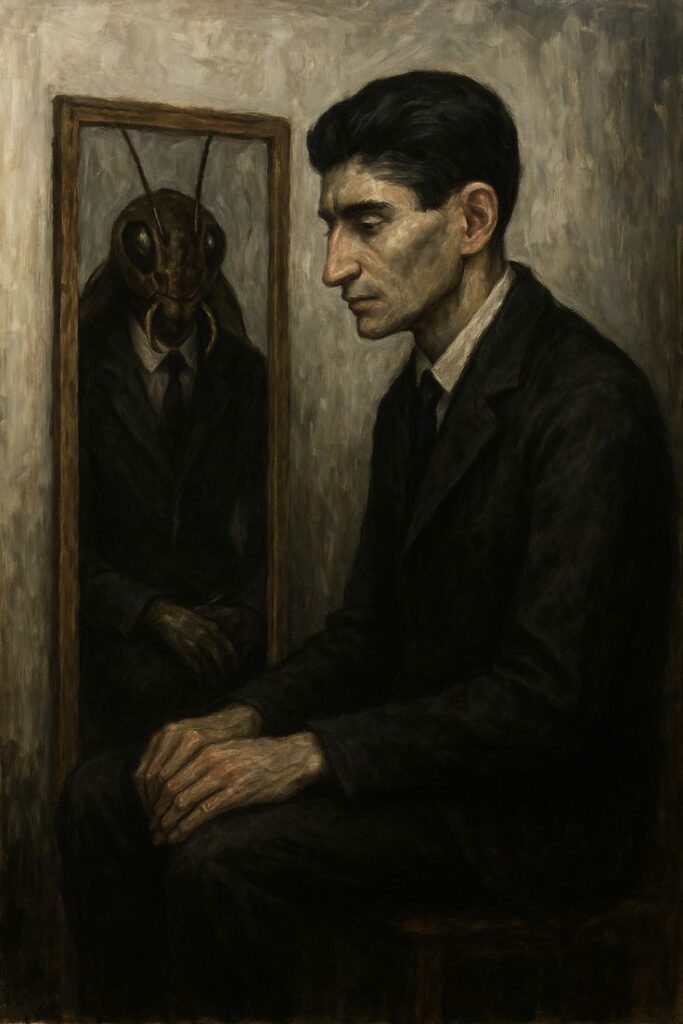
Franz Kafka was a German-language Jewish Czech writer, renowned for his surreal and existential literary works that explore alienation, bureaucracy, and absurdity.
Franz Kafka was born on July 3, 1883, in Prague, then part of the Austro-Hungarian Empire, into a middle-class German-speaking Jewish family. He was the eldest of six children, though two of his brothers died in infancy, and he had three sisters who later perished in concentration camps. Kafka studied law at the Charles Ferdinand University in Prague and worked as a clerk in insurance companies, balancing his professional obligations with his passion for writing.
Franz Kafka’s philosophy centers on the absurdity of existence, human alienation, and the struggle to find meaning in an indifferent world.
Existential and Absurdist Themes
Kafka’s works reflect a worldview in which life is inherently meaningless, and individuals are left to navigate a world that is often incomprehensible and indifferent to their existence. This aligns closely with existentialist philosophy, emphasizing the individual’s experience of isolation, alienation, and anxiety. Characters like Gregor Samsa in The Metamorphosis or Josef K. in The Trial illustrate the profound helplessness of humans when confronted with opaque systems of power and societal expectations. Kafka portrays bureaucratic and social structures as faceless and indifferent, creating a sense of existential despair.
Alienation and Isolation
A central aspect of Kafka’s philosophy is the alienation of the individual. His protagonists are often cut off from meaningful human connection, reflecting the existential condition of being fundamentally alone in the search for purpose. This isolation is not only social but also psychological, as characters struggle to reconcile their inner desires with external pressures, often leading to suffering and anxiety.
The Absurd and the Search for Meaning
Kafka’s narratives frequently explore the absurdity of human existence, where efforts to find meaning or justice are thwarted by incomprehensible circumstances. In The Trial, Josef K. faces a legal system that processes nothing, symbolizing the pointlessness of human endeavors. Similarly, Gregor Samsa’s transformation into an insect in The Metamorphosis can be interpreted as a metaphor for dehumanization and existential crisis. Kafka’s philosophy suggests that while life may lack inherent meaning, individuals are compelled to confront this absurdity, echoing Albert Camus’s reflections on the human condition.
Influences and Broader Context
Kafka’s thought was influenced by existentialist philosophers such as Søren Kierkegaard and Friedrich Nietzsche, who grappled with the absurdity of existence and the individual’s quest for meaning. His work also incorporates elements of surrealism and magical realism, blurring the line between reality and imagination to emphasize the uncertainty and complexity of human experience. Additionally, Kafka’s personal experiences, including his fraught relationship with his father and feelings of social and spiritual disconnection, informed his philosophical outlook.
Key Takeaways
> Life is inherently absurd and often incomprehensible, leaving individuals to confront meaninglessness.
> Alienation and isolation are central to the human experience, as depicted in Kafka’s characters.
> Power and bureaucracy are portrayed as indifferent forces that exacerbate existential anxiety.
> Kafka’s philosophy bridges literature and existential thought, influencing later thinkers like Albert Camus and shaping modern reflections on the human condition.
Kafka’s works invite readers to meditate on the human struggle for meaning, the inevitability of suffering, and the confrontation with absurdity, making his philosophy both timeless and deeply relevant.
A.G. Munson