
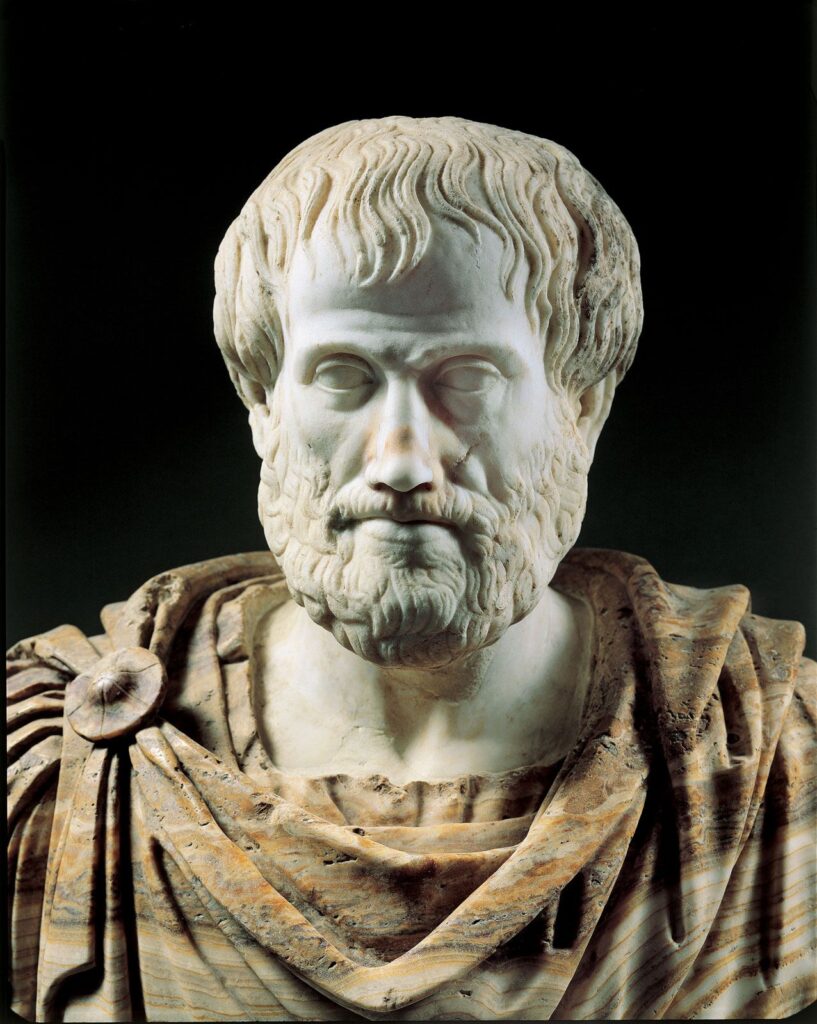
Aristotle (384–322 BCE)
was born in Stagira, Macedonia, and studied under Plato at the Academy in Athens for about twenty years, where he developed a strong foundation in philosophy and science. After Plato’s death, Aristotle traveled and later tutored Alexander the Great, which allowed him to influence both Greek culture and the broader intellectual world. He founded the Peripatetic school at the Lyceum in Athens, where he conducted research and wrote extensively on a wide range of subjects, from biology to politics.
Aristotle’s philosophy
Logic and Reasoning
Aristotle is considered the father of formal logic. He developed the syllogism, a method of deductive reasoning where conclusions are drawn from two premises, such as: “All humans are mortal; Socrates is human; therefore, Socrates is mortal”. His work in logic emphasized the structure of arguments rather than their content, forming the basis of Western logical thought for over two millennia.
Metaphysics and Natural Philosophy
Aristotle rejected Plato’s theory of forms, favoring a more empirical and observational approach. He introduced concepts such as substance, potentiality, and actuality, exploring the nature of being and causality. In natural philosophy, he combined observation with reasoning to study animals, plants, and physical phenomena, laying the groundwork for systematic scientific inquiry.
Ethics and Virtue
Aristotle pioneered Virtue Ethics, emphasizing that moral virtue is achieved through habit and the “Golden Mean”, a balance between extremes of character. He argued that the highest human good is eudaimonia, often translated as flourishing or well-being, achieved through rational activity and contemplation.
Politics and Society
In political philosophy, Aristotle analyzed different forms of government and emphasized the role of the polis in cultivating virtue. He believed that humans are naturally social beings and that ethical life is intertwined with civic participation.
Influence and Legacy
Aristotle’s philosophy profoundly shaped medieval Islamic, Jewish, and Christian thought, influencing scholars like Thomas Aquinas. His works on logic, ethics, and natural science remained central to Western education until the Enlightenment and continue to inform contemporary philosophical debates. His empirical approach and systematic reasoning established him as a pivotal figure bridging philosophy and science.
A.G. Munson