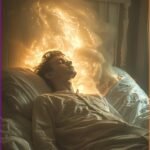

My big sister was 22 when she was diagnosed with cancer in her right leg. She’s three years older than me, so I was 19 at the time. At the hospital they found the cancer wrapped around the nerves throughout her entire leg. The pain grew worse, especially at night.
For a whole year our mother came to her room every evening to wrap warm towels around her leg to dull the pain. I remember walking past her door, seeing my sister lying in bed with our mom sitting beside her. They talked for hours to keep her mind off the pain.
She saw many doctors in Iceland, but the cure was unclear, and her operation kept being postponed. Eventually, my parents had had enough and took her to Georgetown University Hospital in Washington, D.C., for surgery in May-June 1992. They removed the cancer surgically.
The lasting side effect was a limp; she couldn’t run after that.
This experience had a very lasting effect on her and she chose to become a biologist, even completing her PhD in Immunology. I think she did this in part to find a cure for the cancer in the future.
She lived without major problems until 2006 when the cancer resurfaced, this time in her back. She was living in the United States at the time, working as a post doc at Stanford. Thankfully, she had health insurance through her job-essential in a country without universal healthcare. The doctors opened her back and removed a very large tumor.
Every step of the surgery and afterward had to be approved by the insurance company. Two nights after the operation, the insurer hadn’t approved her pain medication for the night. She told me she lay there crying the whole night from the pain. After that she wanted to leave the U.S., which she did and she never returned.
Back in Iceland, she became an assistant professor at the University of Iceland and did cancer research funded by U.S. and European grants. She bought a condo, lived her life, watched my little boys now and then, and I visited her every week.
After a few years the cancer returned, this time in her back and lungs. She went through more treatment: chemotherapy and radiation for a year. She lost her hair again and was left weak. The care was poorly coordinated: one doctor prescribed treatment while another managed pain relief, and the plans didn’t work together.
She tried to return to daily life, but she began fainting on the street. Things seemed to improve for a while, but in late 2012 the cancer came back again, and she was hospitalized. It had spread widely, including to her brain.
They offered another round of chemo therapy, but she couldn’t face it again.
A young stupid doctor told her very casually, that she should make immediate preparations because she would probably die soon. That comment devastated her, stripping away her hope.
Our parents called the hospital and let them know exactly what they thought. After that her mood changed and she became depressed and distant. The worst thing you can do to someone is take away their hope.
That young doctor did that to my sister, and I’ve been wary of doctors ever since.
In early January 2013, my sister went back to the hospital to treat the new brain tumor. She was exhausted but ready to fight.
She never complained, though she had every reason to. She even started a Twitter account to share updates. I visited her often. She was so tired, with little energy, but she still had that fight in her.
On the evening of January 16, 2013, I visited at 7 p.m. and pushed her around the hospital in a wheelchair for about an hour. We stopped at the gift shop, where I bought small white angels to place by her bed. She said she could use all the help she could get.
I also bought her some orange-flavored chocolate, and we went back to her room. We talked about the treatment and how it had to work this time.
The next morning, the hospital called the whole family to come in. When we arrived, my sister was sleeping with an oxygen mask. The doctors took us aside and said her condition had worsened overnight and she could no longer breathe on her own. They didn’t think she had long.
We arranged to take turns being with her. My mother first, then my father from noon until 4 p.m., when I could come from work and be with her. I took my boys to school and went to the office, but my thoughts stayed with her.
I had a big meeting with a CEO of a company at 11 AM and did my job on autopilot, trying to make sense of what was happening. At 2 p.m., my father called my mobile. She died just minutes before.
I stopped breathing for a long time. Just like that she was gone.
A.G. Munson